 | |
|
I am a historian of nineteenth-century France. My research interests are questions of civil society, politics, and the formation of modern public policies.
- Civil Society and NGOs
- Institutions and Modernity
- Politics and Education
- Public Policy and Society
The Seal of the
Société Élémentaire
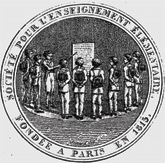
The picture at the top of the page is taken from the official seal of the Société pour l'Enseignement Élémentaire (or simply the Société Élémentaire) in Paris, an organization set up in 1815 to promote schools in France using a new pedagogical approach known as enseignement mutuel. The centerpiece of the technique was using students as tutors (known as moniteurs) for their peers. The scene depicted is the ideal: a moniteur guiding his fellow students through the reading of passages posted on the walls of the school.
A Tale of Two Societies:
Charter Schools in Nineteenth-Century France
(Proposed Book Project)
A Tale of Two Societies: Charter Schools in Nineteenth-Century France is a proposed book-length study of the efforts of two private non-governmental organizations to build and operate “public” primary schools in the French city of Angers between 1817 and 1873. The two organizations detailed in the project, the Catholic Association Religieuse et Royale d’Angers (the Association) and the more politically liberal Société pour l’encouragement d’éducation élémentaire (the Society), between them ran nine schools educating thousands of Angevin children, mostly drawn from the lower classes, for free. These were the only schools offering such education for most of the nineteenth century. Although classified as “public” schools by the French government, these nine schools functioned much more closely to charter schools in the contemporary American context. Funding of such schools was based on a combination of public (most often municipal) subsidies and private funds raised through member subscriptions, the sell of stocks, and donations. In exchange for the municipal subsidies, the schools had to meet certain minimum standards for curriculum, teacher certification, and health. The private organizations, however, retained a significant number of rights concerning the operation of the schools, including selecting teachers, setting large parts of the curriculum, and deciding on when to expand schooling to new areas of the city in response to population growth. Members of these organizations played active roles in the day-to-day affairs for these schools, from conducting classroom inspections and teacher observations to lauding the achievements of students at the annual public school awards ceremonies. By 1873, however, both of these organizations had voluntarily dissolved themselves, transferring their schools to larger institutions (the Catholic Church and the municipal government, respectively) and leaving public education to new groups that confined their activities to lobbying the French government rather than running schools. The book project seeks to describe the foundation, operation, success, and eventual dissolution of these early efforts at public education in favor of larger, centrally directed school systems. I intend the book project to help illustrate the incentives among private actors and government officials to use non-governmental bodies to provide public services, and the constraints of such policies in meeting public expectations of achievement and policing.
The project is a development from my dissertation, entitled “Ceding to the Circumstances: State Institutions, Civil Society, and Running the Schools in Maine-et-Loire, 1815-1875,” completed at Emory University under the direction of Judith A. Miller in August 2009.
Dissertation Abstract and Summary
Civil Society and French Law
"L'
État comme propriétaire? Schools as Property in Nineteenth-Century France," in Institutions and Power in Nineteenth-Century French Literature and Culture, eds. Kate Griffiths and David Evans (Amsterdam and New York: Rodopi Press, 2011), 219-34.
Education and Nationalism
"'Born in France, Naturalized in England': Pedagogy and Nationalism during the Bourbon Restoration," Society for French Historical Studies 56th Annual Meeting, Tempe, AZ, 10 April 2010.
"L'École au Village: The Local in the French Education Pamphlet War, 1817-1824," University of North Carolina-Charlotte Graduate Forum, Charlotte, NC, 28 March 2007.
Civil Society and Professionalization
"Blockheads with Hearts of Gold: Catholic Nobles and the Expansion of Primary Education in Nineteenth-Century Angers," Society for French Historical Studies 57th Annual Meeting, Charleston, SC, 12 February 2011.
Scott A. Gavorsky
Social Sciences Department
Great Basin College
1500 College Parkway
DCIT 121
Elko, NV 89801
(775) 753-2122
scott.gavorsky@gbcnv.edu
| Home | Curriculum vitae | Research | Teaching | Digital Projects | Biography | Links | Great Basin College |